Discussion Response Generator: Brief, Draft and Review
Plan a discussion-board reply from the post, your own viewpoint and permitted source notes. Use the free worked examples and local brief planner below; it creates editable instructions, not an AI response. If your course permits AI assistance, continue into Brainbaby chat for a draft using your available account allowance, then review it yourself.
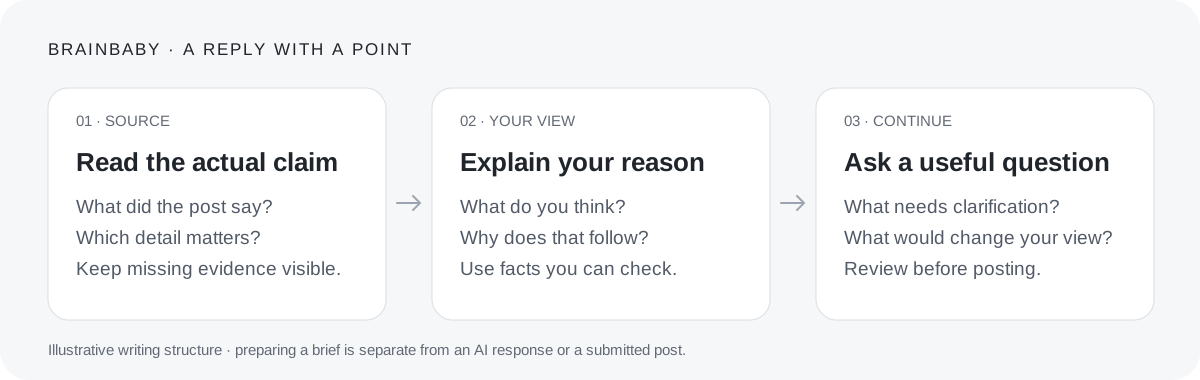
Step by step
Read the task and the specific post
Identify the claim you want to answer rather than summarizing the whole thread. Check your course instructions for the reply length, required readings and allowed use of AI. Supply only a post or excerpt you have permission to share. A discussion reply usually responds to an existing contribution; it is a different task from writing an initial post.
Write down your actual position
State why you agree, disagree or want clarification in your own notes. A useful starting point might be a distinction the post missed, a consequence to examine or an example you can verify. If you are undecided, say so. Do not ask a generator to invent a belief, experience or study result and present it as yours.
Separate evidence from interpretation
Include the relevant passage or your reading notes with the actual source details. Mark a question that remains unresolved. When a source is required but missing, the brief should ask for it to be identified as missing. Do not turn an example into a statistic or invent a citation to make a short reply look researched.
Prepare an editable response brief
Use the planner below to organize the post, your viewpoint, the intended contribution and any constraints. Its fictional example shows one complete setup. Change the prepared instructions before continuing. This local step does not spend AI credits, post a reply or contact classmates.
Review the draft against your notes
Check whether the draft answers the selected claim, preserves your position and adds a useful question or explanation. Verify any source reference against the material you actually supplied. Keep uncertainty visible. A polished paragraph does not establish that its facts or interpretation are correct.
Choose what to use and where to post it
Revise the wording so you can explain the argument yourself. Follow the course requirements for acknowledging assistance where applicable. Copy the reviewed reply into the actual discussion platform only when you choose. Brainbaby does not log into your course, submit work or guarantee a grade through this page.
Three original discussion reply examples
These are authored, fictional examples for a practice discussion. They are not student submissions, AI results, course readings or evidence of learning outcomes. The source post is: “Every project meeting should be replaced by a written update because everyone can read it whenever they want.” No research citation or measured productivity result has been supplied.
Agree with part of the claim and add a distinction
I agree that a written update can make routine progress easier to review at a convenient time. I would separate status reporting from resolving a decision, though. A note can describe what is complete without settling two conflicting priorities. How would the team decide which priority wins when the update leaves that conflict open?
Disagree respectfully and explain the reason
I am not convinced that every meeting should be replaced. The claim treats a routine update and a decision involving several people as the same task. I would use a written update for the first and a focused conversation when the decision remains unclear. What would tell the team that the written format is no longer enough?
Ask for clarification before taking a position
What do you mean by “every project meeting” here: routine status updates, planning sessions or both? The answer matters because those meetings have different purposes. I could support replacing a repeated status report with writing, but I would need to understand how unresolved decisions would be handled before applying the idea to all meetings.
What the examples do and do not establish
They respond to one actual claim
Each reply names the distinction between reporting progress and resolving a decision. The replies do not switch to an unrelated topic or congratulate the author without explaining a point. They leave the other participant something concrete to answer. Choose a structure because it fits your reasoning, rather than attaching a stock compliment to every response.
They do not supply research evidence
The fictional replies explain a position without claiming that a study proves it. If your assignment requires a reading, bring the actual reading or permitted notes into the task and check the reference. Do not add a fabricated author, publication year or percentage. A sample reply cannot establish what your course expects.
They can be changed when the source changes
If the original post only proposes replacing routine status meetings, the disagreement above would misread it. Reread the actual wording before adapting an example. A generator may produce a fluent answer to a claim nobody made. The post, your position and the reply should still match after every rewrite.
How to improve a reply that only says “I agree”
Add your reason rather than another compliment
In the fictional meeting example, explain which part of the claim makes sense to you and why. Then name its boundary: a written update may leave a decision unresolved. This gives the reply a point that someone can discuss. Keep the explanation in proportion to the task instead of expanding it with repeated praise.
Ask a question that follows from that reason
A question such as “What would happen if two priorities conflict?” follows from the distinction in the example. A general “What do you think?” adds less direction. Ask about a term, assumption or consequence that actually affects your interpretation. Do not add a question simply because a template ends with one.
Use feedback to revise your understanding
A reply can leave a position open to revision. If another participant clarifies that the update includes a decision process, acknowledge that detail and reconsider the objection. Save the source and your own notes before changing the draft so you can see what changed. A conversation is useful when it improves the reasoning, rather than only filling a response box.
A short source-based check before posting
The University of Waterloo’s discussion guidance recommends following course-specific instructions, keeping replies focused, explaining the reason for agreement and asking questions that extend the conversation. The linked source is general discussion guidance; it does not endorse Brainbaby or establish your course’s AI policy.
Meaning
Does the reply represent the other post accurately? Can you explain your own reason without rereading an AI answer?
Evidence
Is each quotation, source detail and factual claim supported by the material you checked? Is missing evidence still marked as missing?
Requirements
Does the final wording fit the actual prompt, length and assistance rules? Did you review it in the platform where you intend to post?
Frequently asked questions
Is this a free discussion board response generator?
The worked examples and local brief planner are free without an account. The planner produces editable instructions, not an AI reply. An AI draft is a separate request in Brainbaby chat and uses the available account allowance.
Can it generate a reply without my viewpoint?
A useful brief needs the post and the point you want to contribute. If you are unsure, ask for an explanation or questions to consider rather than presenting an invented viewpoint as your own.
Can I use the generated reply for a class?
Check the course instructions and AI-assistance rules first. Review the wording and sources yourself, and acknowledge assistance when required. This guide does not determine what your instructor permits or guarantee a grade.
Does this post to Canvas, Blackboard or another course platform?
No. The guide prepares a brief, and continuing opens an editable chat draft. It does not connect to a course platform, send a message or submit a reply.
How long should a discussion response be?
Use the length specified in the actual task. If no length is provided, write enough to explain one useful point and a relevant question. Do not add repeated sentences just to reach an arbitrary count.